
October 4, 2026
How should Wisconsin HVAC companies market carbon monoxide safety?
A safety-first Fire Prevention Week content plan for Wisconsin HVAC companies—what to publish, how to route urgent calls, and which claims to avoid.
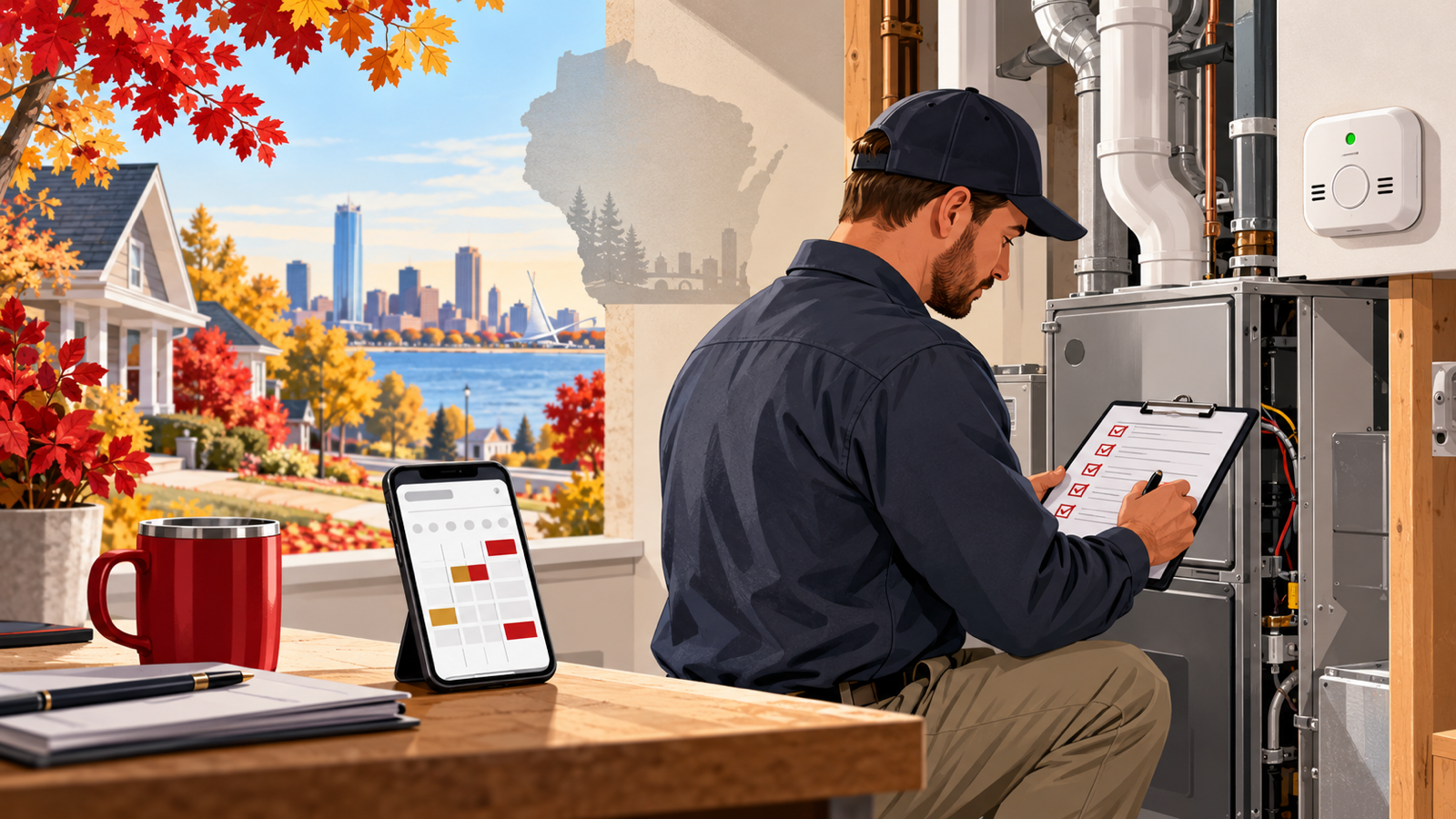
Wisconsin HVAC companies should use carbon monoxide safety content to answer urgent questions, explain the limits of do-it-yourself checks, and give customers a clear path to professional help—not to frighten people into booking. During Fire Prevention Week, publish one authoritative safety page, a short sequence of practical Google Business Profile and social posts, and an intake rule that immediately directs a possible exposure to fresh air and 911 before any sales conversation.
The timing is unusually relevant this week. Fire Prevention Week runs October 4–10, 2026. On October 1, Wisconsin news coverage reported that nine people were hospitalized after a carbon monoxide leak in Fond du Lac County, as local responders warned that calls rise when furnaces return to service.
Public search behavior also supports preparing for heating season. The Google Trends comparison for “carbon monoxide detector,” “furnace inspection,” and “furnace repair” in Wisconsin over the past five years, reviewed October 4, 2026, shows weather-driven and cold-season interest rather than a dependable weekly pattern. Google Trends is normalized from 0 to 100; it does not report search counts, booked jobs, or the cause of a spike. Use it as a timing signal, not a demand forecast.
The short answer: build the campaign around five customer needs
| Customer need | Best content | Operational requirement |
|---|---|---|
| “My alarm is sounding” | A visible emergency instruction | Route outside and to 911; do not start troubleshooting by chat |
| “Is this symptom dangerous?” | Plain-language limits and official guidance | Never diagnose exposure online |
| “Does the test button prove the detector senses CO?” | A concise FAQ | Explain what your technicians can and cannot test |
| “Should my furnace be inspected?” | A service-scope page | State the real inspection scope, price factors, and availability |
| “Who serves my area?” | Accurate local pages and profile details | Keep service areas, hours, and phone routing current |
This is a trust campaign first. Calls and appointments matter, but the content has to remain useful even when the correct next step is calling emergency services instead of your office.
Start with an emergency answer, not a promotional paragraph
The first paragraph of a carbon monoxide page should answer the most consequential question. Wisconsin Department of Health Services says that if a CO alarm sounds or people have possible symptoms, they should move everyone outside, call the local fire department, and stay out until the building is declared safe.
Put that instruction above the appointment button. Repeat it in your phone-tree notes, chat escalation, after-hours answering script, and staff knowledge base. A marketing page that explains detector placement but buries the emergency action is not ready to publish.
Your call handler should distinguish three situations:
- Alarm or possible exposure: direct the caller outside and to 911. Do not keep them on the line for a sales intake.
- No alarm and no symptoms, but a maintenance question: follow your normal scheduling and qualification process.
- A technical question outside your licensed scope: say so, then refer the customer to the appropriate qualified professional or official source.
If an AI receptionist or chatbot is involved, require a human-reviewed emergency rule. This is exactly where the principle in AI for local SEO: keep humans in the loop moves from editorial advice to an operating safeguard.
Publish one durable page before a week of posts
A social post disappears quickly. Build a permanent page or article that your shorter updates can link to. It should cover:
- what carbon monoxide is, in plain language;
- what to do when an alarm sounds;
- common fuel-burning sources without diagnosing a specific home;
- why the test button does not replace following the detector manufacturer’s instructions;
- what your furnace or combustion-safety service actually includes;
- which counties, cities, and equipment types you serve;
- when your office answers and how after-hours calls are routed;
- links to Wisconsin DHS, the detector manufacturer, and emergency guidance.
Wisconsin DHS notes that fuel-burning furnaces, boilers, water heaters, fireplaces, generators, and other equipment can produce carbon monoxide. It also recommends annual professional inspection of furnaces or wood-burning stoves and says Wisconsin homes and multifamily buildings generally need working CO detectors on each floor under state requirements. Link to the state guidance rather than paraphrasing code into a guarantee that may not fit every building.
This durable page can support a Google Business Profile posting cadence without forcing every post to carry the whole explanation.
Use a four-post Fire Prevention Week sequence
Post 1: the emergency action
Lead with one calm instruction: if a CO alarm sounds, get everyone outside and call 911. Link to Wisconsin DHS. Do not add a discount, a countdown timer, or a “call us first” message.
Post 2: the detector check
Show a real team member checking a detector according to its manufacturer instructions. Remind readers that Wisconsin DHS suggests using the spring and fall daylight-saving changes as recurring times to test alarms and address batteries where applicable. Avoid universal replacement claims; product life and maintenance instructions vary.
Post 3: the professional inspection
Explain what your company checks during the service you sell. If combustion analysis, venting inspection, heat-exchanger inspection, detector testing, or written findings are not included, do not imply that they are. Name the credentials or tools your company truly uses, and have a qualified technician approve the copy.
Post 4: local availability
Publish the cities or route zones with real openings. A homeowner in Waukesha should not have to guess whether a Milwaukee company crosses county lines. If the calendar is full, show the next honest opening or an appropriate referral instead of advertising immediate service.
Answer the questions people ask before they call
Useful FAQ content can earn search visibility and make phone conversations more efficient. Start with questions your technicians and dispatchers actually hear:
What should I do if my carbon monoxide alarm sounds?
Move everyone outside, call 911 or the local fire department, and do not re-enter until responders say it is safe. Do not use an HVAC website or chatbot to decide whether the alarm is “real.”
Does pressing the test button mean my detector can sense carbon monoxide?
The test button confirms functions described by that detector’s manufacturer; it is not a substitute for following the product instructions, replacement schedule, and official safety guidance. Do not tell customers to expose an alarm to exhaust or another combustion source.
Can an HVAC company tell me whether my home is safe over the phone?
No responsible company should diagnose a possible carbon monoxide condition remotely. If there is an alarm or possible exposure, leave and call emergency services. A qualified on-site professional can later evaluate equipment within their scope.
Is a furnace tune-up the same as a carbon monoxide inspection?
Not automatically. Service scopes differ. The company should list the included checks, measurements, documentation, and exclusions before the appointment. This specificity is also good local SEO because it answers the service question without stuffing city names into the page.
When should Wisconsin homeowners schedule heating-system service?
Before the system is needed heavily is the practical planning window, but companies should market only the capacity they have. Our Wisconsin fall furnace tune-up marketing calendar explains how to align education, booking, and route availability from late summer through the first cold stretch.
Claims to remove before publishing
Safety content needs a stricter review than an ordinary seasonal promotion. Remove or rewrite language such as:
- “A tune-up prevents carbon monoxide leaks.” Maintenance can identify issues; it cannot guarantee prevention.
- “If the alarm stops, the house is safe.” Only responders or qualified on-site evaluation can resolve the situation.
- “This detector is good for five years.” Use the specific manufacturer’s replacement guidance.
- “Every home needs the same alarm placement.” Point readers to Wisconsin requirements and manufacturer instructions.
- “We guarantee your family’s safety.” No service can make that promise.
- “Book before it’s too late.” Urgency should come from accurate safety instructions and real availability, not fear.
Have a qualified HVAC professional approve equipment claims, and use an official source for emergency directions. AI can help format FAQs or create post variants, but it should not invent inspection steps, code requirements, health advice, or credentials.
Make the local-search details match the operation
Before the campaign starts, verify the practical details that turn useful content into a trustworthy local presence:
- Google Business Profile hours and after-hours phone routing;
- primary and secondary categories that reflect actual services;
- service-area cities and counties;
- furnace, boiler, fireplace, or other equipment types the company truly handles;
- appointment availability and emergency-service limitations;
- consistent name, address, and phone information;
- links from the safety article to the relevant service and location pages;
- photos of real technicians, tools, trucks, and completed documentation, with customer permission.
Do not create a separate thin page for every suburb. A strong service page plus genuinely useful location coverage is more durable than duplicating the same safety paragraph across dozens of city names. See service-area pages without doorway spam for the safer structure.
Measure whether the campaign helped
Track outcomes that connect communication to service quality:
- visits to the durable safety page;
- clicks from Google Business Profile posts;
- calls and forms that mention furnace inspection or CO concerns;
- emergency calls correctly escalated without a sales intake;
- booked appointments by route zone;
- FAQ topics that reduce repeated dispatcher explanations;
- page updates made after technician review.
Do not treat a spike in impressions as proof that the safety campaign created demand. Weather, news, Fire Prevention Week, and other factors can change attention at the same time. The better test is whether customers found the right answer, reached the right channel, and received an accurate description of your service.
A practical 90-minute launch checklist
- Ask a qualified technician to approve the emergency language and service scope.
- Publish or update the durable safety page.
- Add the page to the relevant HVAC service and Wisconsin location pages.
- Prepare four short posts using the sequence above.
- Verify Google Business Profile hours, service areas, and phone routing.
- Test the website form, chat escalation, and after-hours script.
- Schedule a post-campaign review with dispatch and the service manager.
The best Fire Prevention Week marketing will not feel like a promotion. It will feel like a competent local company making a difficult moment easier: the emergency instruction is obvious, the technical claims are restrained, and the next appropriate step is clear.
If your HVAC company needs help connecting the page, profile, intake rules, and follow-up workflow, request a local marketing and automation audit.
Want this applied to your shop?
Book a free audit—we will connect strategy to your counties, trucks, and how you want the phone to ring.
Contact us