
October 18, 2026
When should Wisconsin restaurants market Thanksgiving catering?
An October-to-November Thanksgiving catering marketing checklist for Wisconsin restaurants, caterers, bakeries, and meal-prep businesses.
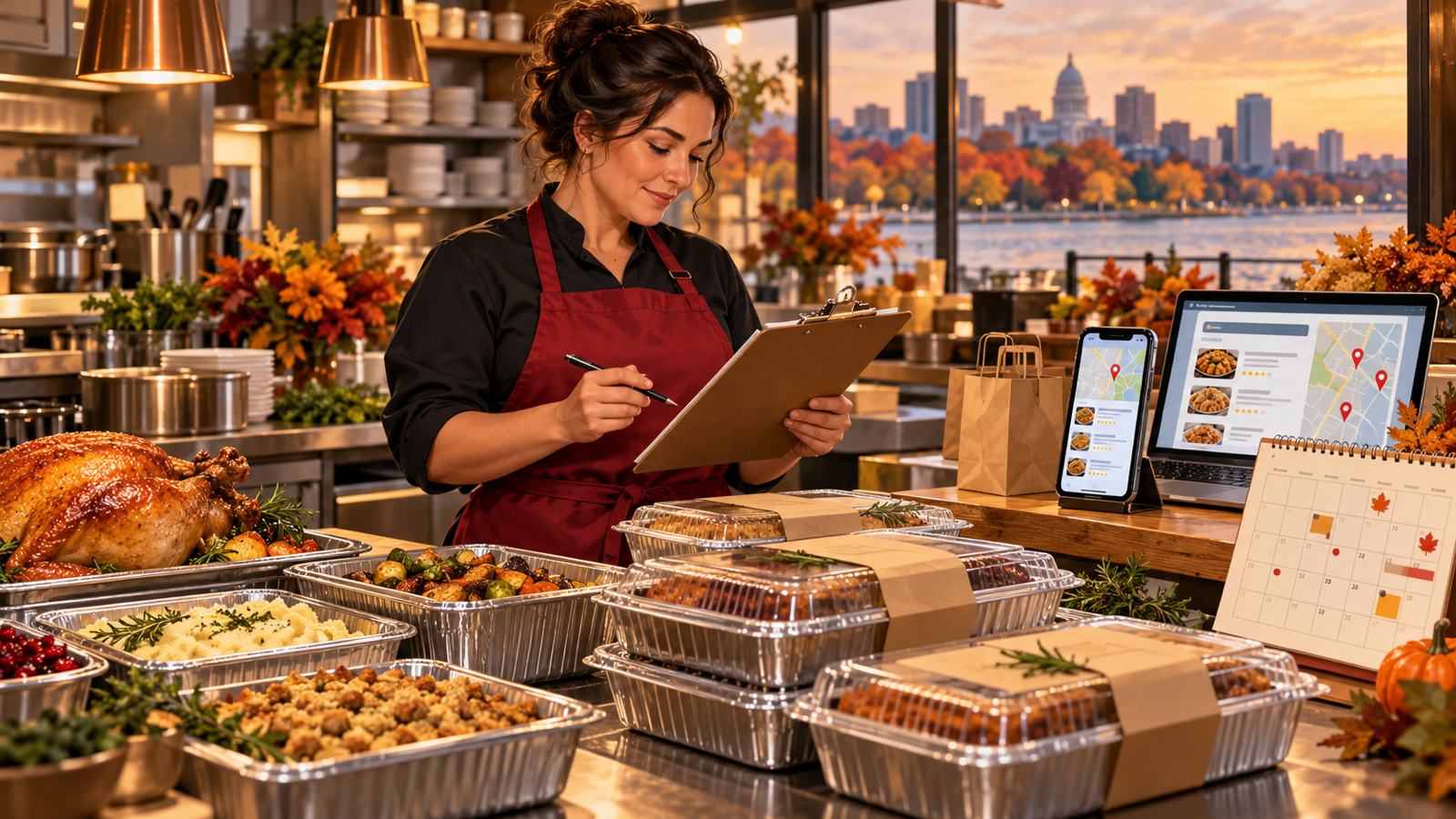
Wisconsin restaurants, caterers, bakeries, and meal-prep businesses should publish their Thanksgiving catering offer in October. By launch day, customers should be able to see the menu, understand serving sizes and deadlines, choose a pickup window, complete an order, and receive an accurate confirmation. November is for answering real questions, showing availability, and closing orders—not for building the process from scratch.
That timing matches current and recurring search behavior. In the public Google Trends view for “Thanksgiving catering” in Wisconsin over the past five years, reviewed October 18, 2026, the weekly index had already moved from 8 during the week of October 4 to 10 during the week of October 11. Prior completed seasons produced their strongest visible readings in the weeks beginning October 31, 2021 (78); November 20, 2022 (69); November 5, 2023 (76); and November 10, 2024 (100). Milwaukee and Madison were tied at 100 in the metro comparison shown.
Google Trends values are normalized relative interest, not search counts, order forecasts, or proof that a specific campaign will sell out. The term is also sparse enough in Wisconsin that many weeks display zero. Use the pattern for timing, not for a revenue claim.
The short answer: build the order path before promoting it
| Timing | Customer-facing work | Operational work |
|---|---|---|
| By October 25 | Publish the complete offer and direct order link | Approve menu, quantities, pricing, pickup capacity, and refund policy |
| Late October to early November | Announce the offer across your website, Google Business Profile, email, and social channels | Test payment, confirmation, inventory, and kitchen tickets |
| Two to three weeks before Thanksgiving | Answer common questions and show accurate availability | Adjust caps and pickup windows using actual order load |
| Final order week | Publish the real cutoff or sellout status | Reconcile orders, production counts, labels, and customer contacts |
| Pickup day | Make directions, parking, and pickup instructions easy to find | Assign exception handling and verify every handoff |
For 2026, Thanksgiving is Thursday, November 26. Your own order cutoff should come from production capacity, supplier deadlines, and pickup throughput—not a generic marketing calendar.
Decide exactly what the customer is buying
A holiday catering page fails when the offer is attractive but ambiguous. Before writing campaign copy, settle the facts that affect a purchase:
- What is included in each package, and which items are optional?
- How many people does each package reasonably serve?
- Are items hot, chilled, frozen, or ready to reheat?
- Which pickup dates, locations, and time windows are available?
- Is delivery offered, and if so, where and at what price?
- What is the final order deadline, and can it move earlier if capacity fills?
- How are allergens, substitutions, cancellations, and refunds handled?
- What should a customer bring or know at pickup?
Put those answers on the order page, not only in a social caption or image. A customer who finds the business through Search should not have to call for basic eligibility and logistics before deciding.
Create one dedicated page that can complete the order
The primary campaign destination should be a dedicated, mobile-friendly page with a clear title, menu, prices, serving guidance, deadline, fulfillment details, and one primary action. If online checkout is available, link directly to the appropriate order flow. If orders require a form or phone call, explain exactly what happens next and when the customer will receive confirmation.
Google says local business links can help customers view a menu, make a reservation, or place a food order. Its business-link policy also says an action link must lead to a dedicated landing page where the designated action can be completed. A general homepage, a social profile, or a link that merely describes catering is a poor substitute for an order path.
Keep the page live long enough to answer post-purchase questions, then update it after the holiday instead of leaving an expired “order now” message in search results. If the offer will return next year, preserve the useful URL and replace the call to action with an honest status and future-update option.
Make Google Business Profile point to the same answer
Google’s restaurant Business Profile guidance covers ordering links, menu content, holiday and service-specific hours, photos, posts, and performance metrics. For a Thanksgiving preorder campaign, check each relevant surface rather than treating a single post as the whole update.
Ordering and menu links
Review every first- and third-party ordering option shown on the profile. Google allows businesses to add and choose a preferred food-ordering link through Business Profile ordering settings. Send customers to the page that reflects the current Thanksgiving offer and location. Test the link while signed out and on a phone.
Do not assume a menu PDF can do the job of checkout. A PDF may help a customer review details, but the primary action should still make the next step obvious and measurable.
Hours and pickup availability
Set accurate special hours for Thanksgiving week and use additional service hours where they apply. A restaurant may be closed for dine-in while still operating a catering pickup window. Explain that distinction on the order page, confirmation message, phone greeting, and pickup instructions so “closed” does not become “my prepaid order is unavailable.”
Posts and photos
Use a Business Profile post to introduce the offer, show the food honestly, state the order deadline, and link to the dedicated page. Google says profile posts can share updates, offers, and event details and can include an action button leading to an order or booking page. Keep the post accurate if a package or pickup window sells out.
Build a campaign sequence around customer decisions
One launch announcement rarely answers every question. A simple sequence can do more useful work without repeating the same sales message.
- Launch: Show the complete offer, who it serves, the order deadline, and the direct action.
- Decision help: Explain package sizes, dietary information, pickup locations, and what arrives ready to serve or reheat.
- Proof: Share original photos of the actual food, packaging, and prior holiday setup when available and representative.
- Availability: Publish honest changes to remaining pickup windows or package availability.
- Deadline: Remind customers of the real cutoff without inventing scarcity.
- Pickup: Send parking, arrival, identification, and contact instructions to confirmed customers.
- Follow-up: Thank customers, provide any promised care instructions, and ask for private operational feedback before planning the next offer.
Connect that sequence to the site’s broader local content strategy so the page, profile, email, and social posts all use the same facts. Automation can adapt approved information into channel-specific drafts, but a named owner should approve availability, prices, deadlines, and fulfillment claims.
Prevent the order system from overselling the kitchen
Marketing and production need one shared capacity model. Track limits at the level that actually constrains the team: total meals, individual dishes, oven or refrigeration space, delivery routes, or pickup slots.
A lightweight system should record:
- order number and customer contact;
- package and add-on quantities;
- payment and refund status;
- fulfillment location, date, and time window;
- dietary or substitution notes that the business has agreed to support;
- production and packing status;
- customer confirmation and reminder status;
- pickup completion or exception reason.
This is a practical use case for workflow and business automation. An approved order can update production counts, create a kitchen or packing task, send a confirmation, and schedule a pickup reminder. Keep a person responsible for exceptions; software should not guess at allergen safety, accept an unsupported substitution, or promise inventory that the kitchen has not confirmed.
Design the confirmation for fewer Thanksgiving-week calls
The confirmation should be more than a receipt. It should repeat the facts customers are most likely to forget:
- what they ordered and paid;
- pickup location, date, and assigned window;
- parking or entrance instructions;
- whether the order will be hot, chilled, or frozen;
- any approved reheating or storage instructions supplied by the kitchen;
- what name or order number to provide;
- how to report a change or problem;
- cancellation and refund terms.
Send a reminder close enough to pickup to be useful. If a customer replies, route the message to a monitored inbox or queue. An automated reply that says “someone will contact you shortly” is harmful when no one owns the response.
Keep local SEO claims precise
Write for the places the business can actually serve. A Milwaukee pickup location can naturally mention Milwaukee and nearby customers, but it should not create thin city pages for every suburb or imply delivery across southeastern Wisconsin if the team cannot fulfill it.
Link to the correct location page, use the real business name, and keep address and phone details consistent. Badger Automation Group’s guide to Google Business Profile optimization in southeastern Wisconsin explains the broader profile basics. For multi-location restaurants, each ordering link and pickup instruction should resolve to the correct location rather than a generic brand page.
Measure the campaign as an order system
Do not judge the campaign only by impressions or profile views. Track the stages that show whether customers could act:
- visits to the Thanksgiving catering page by source;
- menu or order-link clicks from the Business Profile;
- checkout starts and completed orders;
- phone or message inquiries that the page did not answer;
- orders by package, add-on, location, and pickup window;
- abandoned or failed payments;
- sellout timing and unused production capacity;
- pickup wait time, missing orders, and no-shows;
- refunds, corrections, and customer feedback.
Use simple, documented attribution. A customer may see a social post, search the business later, and order from a saved link. Avoid claiming that every sale came from the last click or that a rise in Google Trends caused the business’s results.
A 90-minute prelaunch test
Before promoting the offer, have someone who did not build it complete this check on a phone:
- Find the offer from the homepage and a branded Google search.
- Confirm the menu, prices, serving guidance, deadline, and fulfillment details agree.
- Follow the preferred Google ordering link.
- Place a test order through the full payment or request path.
- Read the confirmation and reminder as a customer would.
- Verify the order appears in the correct production and pickup workflow.
- Test a sold-out item or full pickup window.
- Call the public number and confirm the team can answer Thanksgiving-order questions.
- Check the page and checkout at a narrow mobile width.
- Assign one person to update public availability when capacity changes.
The best time to market Thanksgiving catering is when the order experience is ready, and in Wisconsin that should usually be October. Search interest can rise quickly in November; the restaurants that benefit are the ones that have already connected the offer, local profile, checkout, production limits, confirmation, and pickup plan.
If your restaurant or catering business needs help connecting local search, holiday campaign content, ordering, and follow-up, request a local marketing and automation audit.
Want this applied to your shop?
Book a free audit—we will connect strategy to your counties, trucks, and how you want the phone to ring.
Contact us