
August 9, 2026
When should Wisconsin chimney sweeps start fall marketing?
An August-to-first-fire marketing calendar for Wisconsin chimney sweeps and fireplace service companies that want to book inspections before the fall rush.
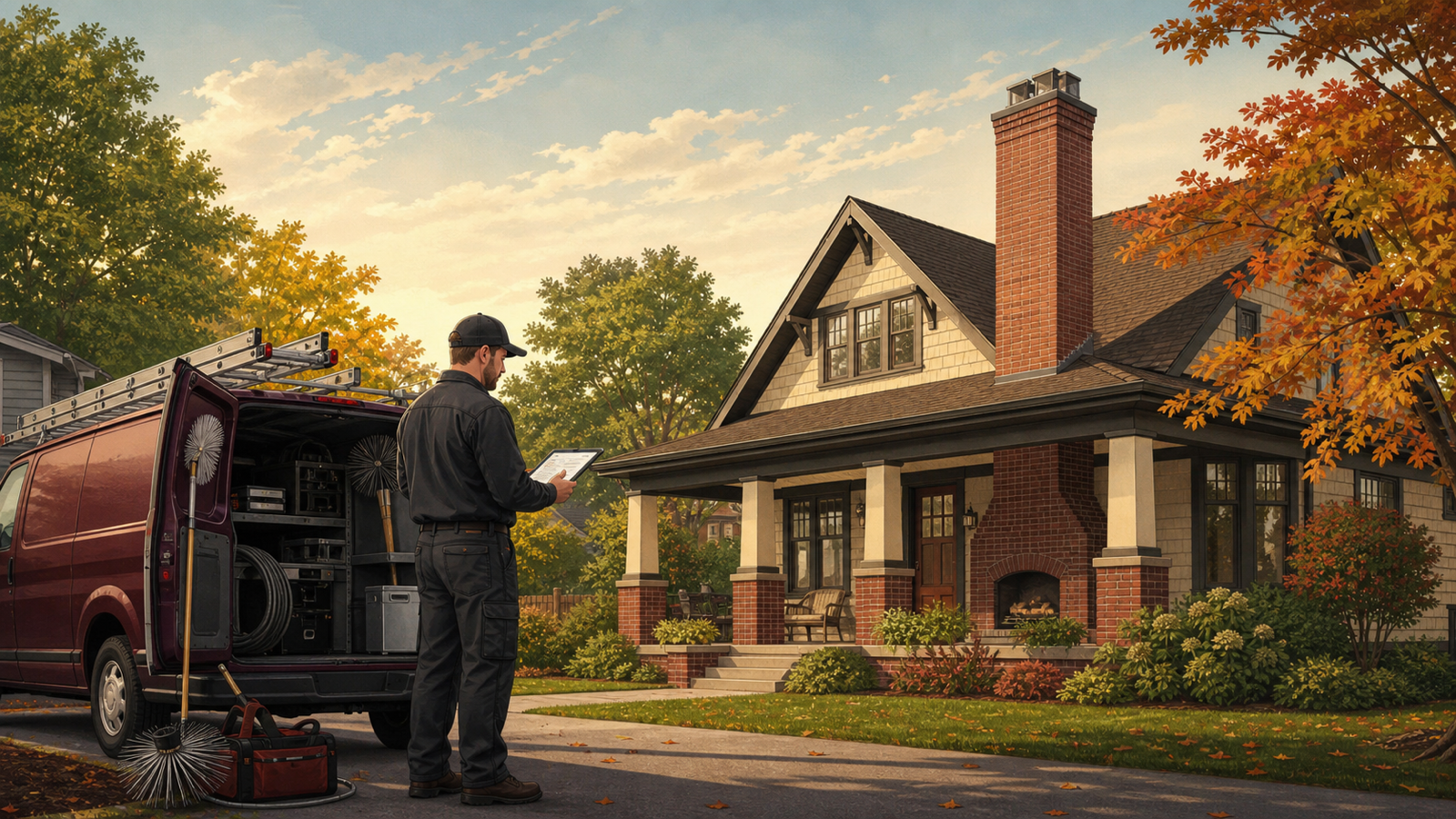
Wisconsin chimney sweeps should start fall marketing in early August, while homeowners still have time to schedule an inspection before the first fire of the season. Use August to explain the difference between an inspection and a cleaning, reactivate past customers, and open priority booking. Use September to build route density and publish current proof. Once cold nights arrive, switch from broad promotion to honest availability and urgent-but-not-alarmist safety guidance.
This is a planning recommendation, not a promise of exact demand. The public Google Trends comparison for “chimney cleaning,” “chimney sweep,” and “fireplace cleaning” in Wisconsin over the past five years, accessed August 9, 2026, shows the strongest recurring clusters for “chimney cleaning” and “chimney sweep” in September and October in several of the five years. The same chart is sparse—many Wisconsin weeks report zero because the sample is small—so it does not support an exact demand forecast. It does show early movement in 2026: relative interest for “chimney cleaning” moved from 12 for the week of July 26 to 18 for the week of August 2, while “chimney sweep” moved from 17 to 23. Google Trends normalizes results on a relative 0-to-100 scale rather than reporting search counts, so use those values to validate timing—not to estimate leads.
The service has a real preseason use case. The City of Fitchburg Fire Department advises homeowners to have a chimney inspected and cleaned before each heating season by a qualified sweep. The U.S. Environmental Protection Agency likewise records fire officials’ recommendation for a professional annual inspection of wood-burning appliances, chimneys, and vents. For a chimney company, the useful marketing message is not “your house is in danger.” It is “inspect before use, understand the condition, and schedule any necessary work while there is still room on the calendar.”
The short answer: use a four-stage campaign
| Window | Homeowner question | Marketing job |
|---|---|---|
| Early to mid-August | “Why think about the fireplace now?” | Explain preseason timing and reactivate past customers |
| Late August through September | “Do I need an inspection, cleaning, or repair?” | Clarify services, show proof, and build routes by geography |
| First cool nights | “Can someone come before we use it?” | Keep availability accurate and make booking frictionless |
| After the calendar fills | “What should I do while I wait?” | Set expectations, triage responsibly, and capture future work |
The calendar should follow actual technician capacity. If the next inspection slot is three weeks out, say so. Do not keep advertising “book before the rush” after the rush has already filled every route.
August: separate inspection, cleaning, and repair in plain language
Many homeowners use “chimney cleaning” as shorthand for several different needs. Your website and Google Business Profile should explain that an inspection evaluates condition, a cleaning removes deposits or obstructions when appropriate, and repair is a separate scope based on what is found. Avoid diagnosing a chimney from a photo or implying that every inspection automatically requires a sweep.
Before the campaign launches, align these details across the profile, landing page, booking form, and call script:
- Which chimney, fireplace, stove, and venting systems your team services.
- Whether inspection and cleaning are booked together or separately.
- What the base appointment includes and what can change the scope.
- Whether camera inspection, caps, liners, masonry, waterproofing, or animal removal require a different appointment.
- Which Milwaukee-area and southeastern Wisconsin communities fit the route.
- What the customer should do before the visit, including access and appliance-use instructions approved by your technician.
If those details differ by technician or vehicle, fix the operation before scaling the campaign. Our workflow and business automation service can help connect the intake form, calendar, reminders, and follow-up so the customer hears one consistent answer.
Build the campaign around “before first use,” not fear
Useful safety information gives homeowners a reason to act without turning the page into a scare tactic. Wisconsin DHS explains that poorly vented or malfunctioning appliances and leaking chimneys can increase carbon-monoxide risk. It also recommends annual professional inspection of furnaces or wood-burning stoves and notes that Wisconsin homes and multifamily buildings must have carbon-monoxide detectors on each floor.
Turn that guidance into calm, accurate content:
- “Schedule the inspection before you plan to use the fireplace.”
- “Know whether the appointment is an inspection, cleaning, or repair estimate.”
- “Test carbon-monoxide detectors according to the manufacturer’s instructions.”
- “If a carbon-monoxide alarm sounds, move outside and call the fire department; do not treat a marketing page as emergency advice.”
Do not claim that a cleaning prevents every fire, guarantees safe operation, improves indoor air quality in every home, or satisfies every insurer. Those claims depend on system condition, technician findings, and policy terms.
Use September to build route density
Chimney work can lose margin when appointments zigzag across seven counties. The campaign should help the dispatcher cluster demand without pretending the company has an office in every town.
Use separate weekly pushes for real service zones—for example, Milwaukee and Wauwatosa, Brookfield and Waukesha, or Mequon and Cedarburg—only when those groupings match how trucks actually run. Link ads and profile posts to one useful service page, then collect the address early enough to confirm coverage.
A simple routing workflow can:
- Capture the property address, appliance type, requested service, and preferred timing.
- Flag requests that need a technician review before scheduling.
- Offer only appointments assigned to the correct service zone.
- Send preparation instructions after the booking is confirmed.
- Ask for a review after completed work without incentives or review gating.
That is a good use of AI lead capture when a human still reviews safety-sensitive answers and unusual systems. For a broader view of responsible automation, see our guide to keeping humans in the loop for local SEO.
Refresh Google Business Profile before promotion starts
Do not send more people to an incomplete profile. Before the first campaign post, verify:
- The primary category and secondary categories reflect the business accurately.
- Service areas match where the company can actually take appointments.
- Main and special hours match when someone answers or follows up.
- The phone number, booking link, and website destination work on a mobile device.
- Service descriptions distinguish inspections, cleanings, and repairs without keyword stuffing.
- Recent photos show real technicians, equipment, roofs, chimneys, or fireplaces with customer permission.
Then publish a small sequence rather than repeating the same offer every week: one preseason explanation, one “inspection versus cleaning” post, one recent-job proof post, and one availability update. Our Google Business Profile service and local SEO service cover the profile-to-landing-page handoff.
Answer the questions that block a booking
An answer-engine-friendly page should resolve the questions a homeowner would otherwise ask on the phone. Give direct, technician-approved answers to:
- How long should the appointment take?
- Does the fireplace need to be unused before the visit?
- Will the technician need roof access?
- How do inspection levels or camera work differ?
- What happens if an animal, damaged liner, cracked masonry, or water entry is found?
- Does the team service gas fireplaces, wood stoves, inserts, or only masonry fireplaces?
- Which findings can be addressed during the same visit and which require a written estimate?
If the answer varies, say what it depends on. Clear qualification can reduce unproductive calls while making strong-fit customers more comfortable booking.
Show proof that helps a homeowner evaluate the work
Generic stock flames do not demonstrate inspection quality. Build a photo workflow around evidence that can be shared responsibly:
- A clean vehicle and protected work area.
- Inspection equipment and technician credentials.
- Before-and-after conditions when the comparison is accurate and approved.
- Common components labeled in plain language.
- A short explanation of what the technician documented and what happened next.
Never publish a customer address, identifying paperwork, alarm code, or interior photo without permission. A lightweight local content workflow can collect field photos, route them for approval, and turn approved material into profile posts and service-page updates.
What to measure through the fall rush
Track business outcomes weekly, not just impressions:
- Inspection and cleaning requests by source.
- Booking conversion rate by landing page.
- Lead-to-appointment time.
- Route density and drive time by service zone.
- Cancellations and reschedules after reminders.
- Repair estimates created from completed inspections.
- Reviews requested and received after eligible jobs.
Use campaign tags and call tracking only in ways that preserve a clean customer experience. If a channel produces plenty of calls but most are out of area or asking for a service you do not provide, fix the targeting and page language instead of calling the campaign successful.
The practical August checklist
Before the end of the month:
- Confirm service scope, coverage, pricing logic, and honest appointment capacity.
- Publish one page that clearly distinguishes inspection, cleaning, and repair.
- Update Google Business Profile services, hours, photos, and booking destination.
- Reactivate past customers with a preseason reminder and an easy opt-out.
- Create route-based September promotion windows.
- Prepare technician-approved FAQs and safety language.
- Test every form, phone path, confirmation, and reminder on mobile.
- Pause or revise promotion as soon as advertised availability stops matching the calendar.
Starting in August gives a Wisconsin chimney service company time to educate, qualify, and route customers before colder nights compress every request into the same few weeks. The advantage is not louder marketing. It is a clearer offer connected to a booking system the crew can actually fulfill.
Want this applied to your shop?
Book a free audit—we will connect strategy to your counties, trucks, and how you want the phone to ring.
Contact us