
May 21, 2026
Google review tactics that will get your business penalized in 2026
Mass email blasts, tablet kiosks, and review spikes are now actively hurting local rankings. Here is what changed—and how to build a compliant review engine that keeps you in the Map Pack.
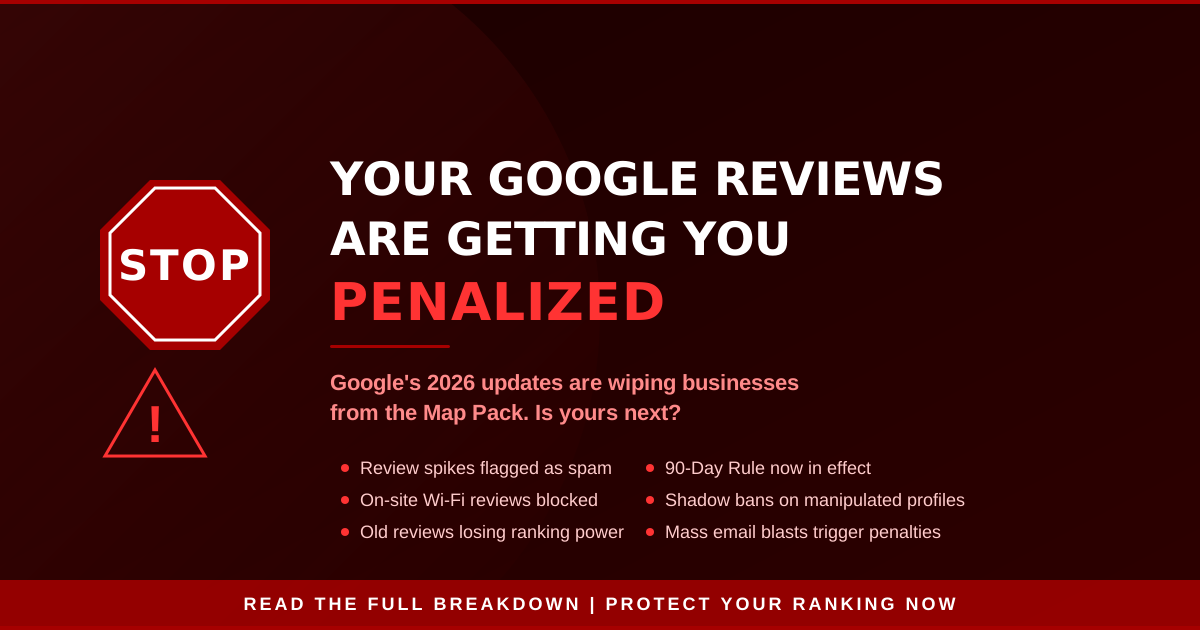
If you are still sending out mass email blasts once a quarter to beg for reviews—or having customers use a shared tablet at your checkout counter—you are actively hurting your Google ranking. That is not speculation. With Google’s strict 2026 updates, the old ways of getting reviews will get your business penalized, shadow-banned, or wiped from the Map Pack entirely.
This is a breakdown of what changed, why the old playbook no longer works, and what a compliant review system actually looks like.
The 90-Day Rule is real—and it is reshaping local rankings
Google now heavily weights review recency. The industry calls it the 90-Day Rule: reviews older than roughly 90 days carry significantly less ranking weight than fresh ones.
What this means in practice: a competitor with 15 reviews from the last two months can easily outrank you—even if you have 150 reviews from last year. Volume alone no longer wins. Velocity and consistency do.
If your last review push was a quarterly campaign, those reviews are already depreciating. The businesses climbing the Map Pack right now are the ones generating a steady, weekly trickle of feedback—not the ones sitting on a pile of aging five-star praise.
What to do about it:
- Stop treating reviews as a quarterly project. They need to be an always-on system.
- Audit your review timeline. If there is a gap longer than two weeks, that gap is hurting you.
- Prioritize fresh, recent reviews over chasing a higher total count.
Review spikes look like spam—and Google’s AI is watching
If you run a “review blitz” and collect 30 reviews in a single weekend, Google’s updated AI moderation flags it as artificial manipulation. The result: those reviews get deleted, your listing gets suppressed, and in some cases your profile gets a manual review that can take weeks to resolve.
Google does not want bursts. They want a natural, steady cadence of feedback that mirrors how a real business operates. A shop that does ten jobs a week should not suddenly have 30 reviews appear on a Saturday afternoon.
The pattern Google rewards:
- A few reviews per week, spaced naturally across days.
- Variation in review length, detail, and rating (all fives with one-line text looks manufactured).
- Reviews from accounts with real history—not fresh Gmail accounts created that morning.
The pattern Google punishes:
- Sudden spikes after long silences.
- Clusters of reviews from the same IP range or geographic area in a short window.
- Templated review language that reads like everyone got the same script.
On-site Wi-Fi reviews are getting blocked
This one catches a lot of businesses off guard. If customers leave reviews while connected to your business Wi-Fi, Google flags the duplicate IP address and hides the review. In some cases it flags the entire batch of reviews originating from that IP.
The tablet-at-the-counter approach that worked in 2022 is now a liability. Google’s systems treat multiple reviews from a single IP as coordinated activity—which, technically, it is. Even if every review is genuine, the signal looks artificial to an algorithm that is scanning for manipulation patterns.
Why this matters for trades and service businesses:
- Shops with a waiting area where customers connect to Wi-Fi are especially exposed.
- “Leave us a review before you go” prompts on an in-store tablet are now risky.
- Even if the reviews are authentic, the IP clustering can trigger suppression.
The fix: Reviews need to come from the customer’s own device, on their own network, after they leave your location. That is the only pattern Google consistently trusts.
Mass email blasts are the wrong tool for reviews
Quarterly email campaigns—“Hey, it has been a while, mind leaving us a review?”—were never great. Now they are actively harmful for two reasons:
- Timing is wrong. A customer who had service done three months ago has already forgotten the details. Their review will be generic, short, and low-value to Google’s algorithm.
- Volume is wrong. Sending 500 emails on the same day creates exactly the kind of spike Google penalizes. Even if only 20 people respond, those 20 reviews landing in the same 48-hour window look manufactured.
The right approach is individual, timely outreach—ideally within hours of service completion, when the experience is fresh and the customer is most likely to leave a detailed, genuine review.
What “compliant” actually means in 2026
Google’s guidelines have always prohibited incentivized reviews, review gating (only asking happy customers), and fake reviews. The 2026 updates go further by using behavioral signals to detect manipulation even when individual reviews are technically real.
A compliant review system:
- Asks everyone. No gating. Every customer gets the same neutral invitation. This is non-negotiable under Google’s terms.
- Asks once, at the right time. A single friendly prompt after service—not a drip sequence of three follow-ups.
- Spaces requests naturally. One or two invitations going out per day, matching your actual job volume.
- Uses the customer’s own device and network. No shared tablets, no in-store kiosks, no QR codes that route through your business connection.
- Never scripts the review. The customer writes in their own words. Suggested text or templates are a fast path to detection and deletion.
The steady trickle: why Google rewards consistency
Think about what a healthy, trustworthy business looks like from Google’s perspective. It has customers coming through regularly. Those customers occasionally leave feedback—some detailed, some brief, some five stars, some four. The reviews arrive in a natural rhythm that mirrors the pace of actual business operations.
That is the signal Google is optimizing for. Not volume. Not perfection. Consistency and authenticity.
The math is simple:
- A business doing 10 jobs a week that converts 15-20% of customers into reviewers generates 6-8 reviews per month—naturally, without any pressure.
- That steady stream keeps the 90-Day Rule working in your favor.
- It never triggers spike detection because there is no spike—just a reliable cadence.
- Each review is unique because each customer had a different experience.
Compare that to the quarterly blitz: 30 reviews in one week, then silence for three months. Google sees the spike, flags it, and suppresses some or all of those reviews. Meanwhile, your competitor’s steady trickle of three reviews per week quietly overtakes you.
How to fix this without lifting a finger
You do not need to chase people down or risk breaking Google’s rules. The solution is a fully automated, compliant review system that handles the entire process.
How it works:
- Trigger after service. When a job is marked complete in your CRM or dispatch system, the automation fires.
- Neutral, friendly outreach. The customer receives a text or email—not a plea for five stars, but a simple invitation to share their experience.
- Natural spacing. The system staggers outreach so reviews arrive at a steady pace, never in a suspicious cluster.
- Their device, their network. The customer responds on their phone, on their own time, from wherever they are—exactly the pattern Google trusts.
- No gating, no scripting. Every customer gets the same invitation. What they write is entirely up to them.
The result is a perfectly timed, steady stream of authentic reviews that keeps Google’s algorithm happy and keeps you at the top of local search results.
What happens if you do nothing
The businesses that ignore these changes will watch their Map Pack position erode—slowly at first, then suddenly. Here is the timeline:
- Month 1-2: Older reviews lose weight. Competitors with fresh reviews start appearing above you.
- Month 3-4: Your review velocity flatlines. Google’s algorithm interprets silence as inactivity.
- Month 6+: A competitor running a compliant automation system has 30-40 fresh reviews. You have the same stale profile from last year. The gap becomes very difficult to close.
The businesses that adapt now—building a steady, automated, compliant review engine—will own the top of local search for the foreseeable future. The ones still running quarterly email blasts will spend the next year wondering why their phone stopped ringing.
Bottom line
Google does not want you to stop getting reviews. They want you to stop gaming the system. The new rules reward businesses that earn feedback naturally, consistently, and without manipulation.
If your current review strategy involves any combination of mass emails, shared tablets, review spikes, or long silences between campaigns—it is time to replace it with a system that works the way Google now expects.
A compliant automated review system is not a nice-to-have. For any business that depends on local search, it is now table stakes.
Want this applied to your shop?
Book a free audit—we will connect strategy to your counties, trucks, and how you want the phone to ring.
Contact us